Start with the image, not the fixture
A gobo is a stencil placed in the optical path. Its job is to break a round pool of light into a shape that carries meaning: a window, a leaf, a texture, a logo, a hard-edged graphic. Before comparing fixtures, write down what the image has to do. Is it decorative texture that only needs to suggest depth, or a brand mark that must be recognisable from the back row? Those two goals lead to different materials, different artwork and different beam angles.
The second question is scale. A pattern that fills a four-metre pool looks bold and legible; the same pattern projected to twelve metres becomes a faint grey smudge with soft edges. This is not a fixture fault. It is the physics of projecting a small transparent image over a long distance, and it is the most common reason a gobo looks disappointing in a venue after looking impressive in a demo room.
Third, decide whether the image must move. A static pattern that sits still on a wall is a lighting-design element. A rotating pattern that drifts across a surface is an effect. Both are useful, but they place different demands on the gobo wheel, the indexing system and the artwork itself.
Rotating and static positions do different jobs
Most professional moving heads provide two gobo positions: a rotating wheel, where the gobo sits in a carrier that can spin or index to a precise angle, and a static wheel, which holds fixed patterns that only pass through the beam. The distinction is mechanical, but it drives design decisions.
- Rotating positions suit breakups, water and foliage textures, and anything that benefits from continuous drift or a repeatable indexed angle.
- Static positions suit hard graphic shapes, logo projection and patterns used as sharp accents rather than atmosphere.
- Rotating carriers usually accept a thicker assembly, which affects which gobo materials are practical.
- Static wheels typically hold more patterns, so they are the place to keep a wide library of accents.
- A pattern that must return to exactly the same angle for every cue belongs in an indexing rotating position, not a free-spinning one.
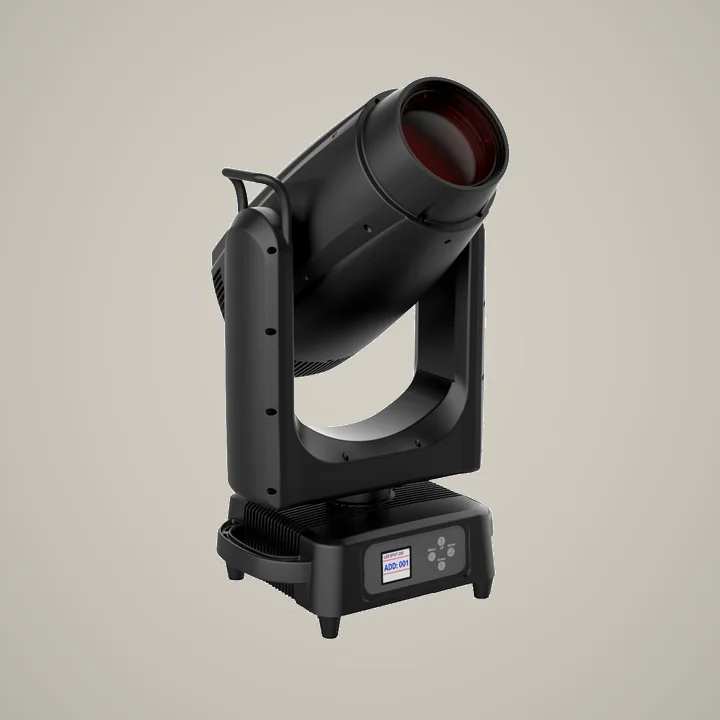
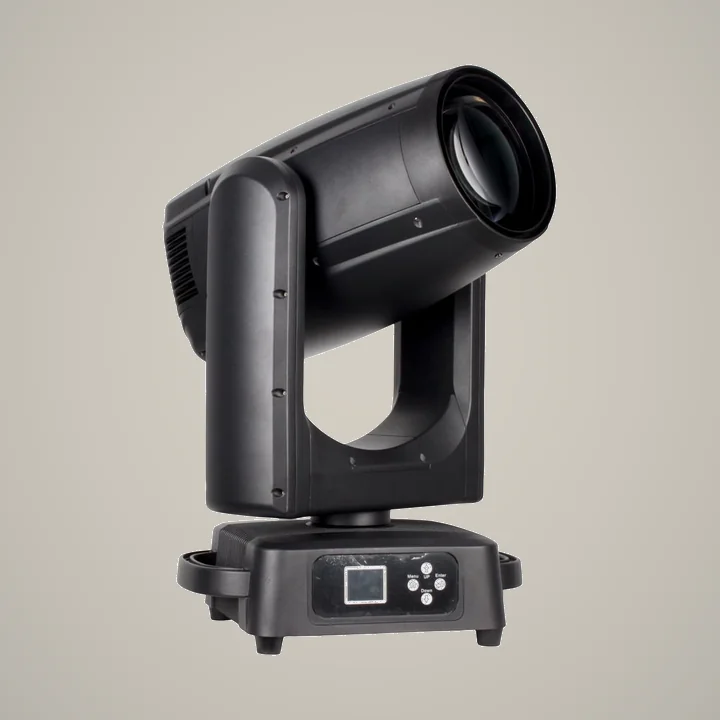
Check the fixture record rather than assuming. A model described as having rotating and static gobos, such as the HL400PRO, gives you both options, but the accepted gobo diameter and carrier format still have to be confirmed with the manufacturer before any custom glass is ordered.
Metal, glass and what each material can hold
The material determines how fine the detail can be, how the edge behaves and how the gobo survives heat. There is no universally better choice; there is only the right choice for a specific image in a specific fixture.
| Material | Strengths | Limits to plan for |
|---|---|---|
| Metal | Durable, tolerant of heat, clean hard edges on bold shapes | Cannot hold very fine detail or thin bridges, and produces no colour |
| Standard glass | Finer detail and smoother edges than metal, supports colour coating | More fragile in handling and less tolerant of thermal shock |
| High-detail glass | Very fine line work, photographic-style greyscale and subtle texture | Highest cost and the most careful handling, cleaning and storage |
The practical rule is to design down to the material. A logo with hairline strokes and small negative spaces will not survive as a metal gobo, and forcing it produces a shape that fills in as soon as the lens is slightly out of focus. Either simplify the artwork or move to glass, and if you move to glass, plan the handling routine at the same time.
Detail survives only at the right beam angle
Beam angle controls how much of the gobo is used and how large the image becomes. A narrow beam throws a small, bright, high-contrast image a long way. A wide beam spreads the same light over a larger area, which reduces intensity per square metre and softens the apparent edge. The gobo does not change; the presentation does.
This is why the same fixture can look excellent on a six-metre throw and weak on an eighteen-metre throw with the same pattern. To judge whether an image will read, work from three numbers: the pattern's smallest feature, the beam angle you intend to use, and the distance to the surface. If the smallest feature subtends too little angle at that distance, no amount of focus will recover it.
A useful discipline is to pick the gobo after the throw and beam angle are fixed, not before. Designers who choose a pattern first often end up widening the beam to fill the space, which is exactly the change that destroys the detail they wanted.
Focus, edge quality and the gobo plane
A gobo only looks sharp when it sits in the correct plane of the optical system and the lens is focused at the working distance. Fixtures with a wide zoom range, such as the 2–40° range on the HL400PRO and HT420BSW, move internal groups as the angle changes, so focus behaviour differs at the two ends of the range. Check both ends, not just the middle.
Edge quality is also a function of the gobo itself. A laser-cut metal edge is sharp but slightly ragged at high magnification, while a glass gobo with an etched or coated pattern can hold a cleaner line. Neither is wrong. What matters is that the edge character matches the design intent, because a soft breakup texture looks intentional while a ragged hard-edge logo looks like a defect.
Frost and prism effects interact with gobos, and the combination is worth testing rather than assuming. A light frost can soften a hard pattern into something usable as atmosphere; a heavy frost may erase it. Prisms multiply the image, which can turn a clean graphic into visual noise if the pattern already carries a lot of detail.
Rotation, indexing and the motion you actually need
Continuous rotation is the effect most people picture, but indexed positioning is often more valuable in structured shows. Indexing lets a pattern land at a repeatable angle cue after cue, which matters when a gobo has an obvious orientation, such as text, an architectural shape or a directional texture. Free rotation on a directional pattern will eventually park it upside down.
Rotation speed and direction also affect how the pattern reads. A slow drift suggests water or foliage; a fast spin turns any pattern into a strobing effect that can be uncomfortable for an audience and difficult to photograph. Plan the speed range you need and confirm that the fixture's rotation is smooth at the low end, since cheap mechanisms often step visibly at very slow speeds.
Custom artwork: what to send
Custom gobos fail more often from artwork preparation than from manufacturing. Suppliers need vector artwork with clean paths, closed shapes and no stray anchor points, plus a clear statement of which areas should pass light and which should block it. A photograph is a starting point for a conversation, not a production file.
- Send vector files with outlines converted, and state the intended physical gobo diameter.
- Confirm whether the design is positive or negative, meaning whether the shape is the light or the shadow.
- Remove features thinner than the material can hold, and widen small gaps before production rather than after.
- Ask for a proof or a rendered simulation at the intended throw distance.
- Approve the artwork in writing, and keep the approved file with the order record.
- Order a spare for any gobo that is critical to a cue, especially glass.
The most expensive mistake in custom gobos is discovering at the venue that a thin line has closed up, or that a pattern reads as its own negative because the polarity was never confirmed. Both are cheap to catch at the artwork stage and expensive to fix on site.
Test before you commit to a full set
A demo room test is useful only if it reproduces the show conditions. Set the fixture at the trim height you will actually use, aim it at the real distance, and run the gobo at the beam angle and focus you plan to programme. If the surface is a dark set piece rather than a white wall, test on something similar, because contrast depends heavily on what you are projecting onto.
Photograph the result at the brightness the audience will see, not with the room lights up. A phone snapshot at full ambient light flatters almost any pattern. If the design depends on a specific colour, test with the colour in the beam, since a saturated wash reduces the apparent sharpness of a fine pattern.
When several fixtures share a cue, test them together. Gobo orientation, rotation phase and focus can differ slightly between units, and a row of patterns that are each acceptable alone can look uneven as a group. Correcting this in programming is far easier than correcting it after the rig is flown.
Handling, cleaning and replacement
Gobos are optical components and should be treated as such. Handle glass by the rim or with gloves, store each one in its own sleeve, and never stack them. Fingerprints on the coated surface bake on under heat and become permanent, which is a slow and avoidable way to lose an expensive pattern.
Cleaning should follow the manufacturer's guidance: a soft brush or clean air first, then an approved optical cleaner on a lint-free wipe if needed. Solvents that attack coatings, and any abrasive cloth, will destroy a glass gobo's surface even though the pattern itself looks intact.
Build a small spares kit around the patterns that matter. For a touring show, that means duplicates of the two or three gobos that carry key cues, in the material actually used, kept with the fixture spares rather than in a separate case that never travels. Replacement during a changeover should take minutes, and it only does if the correct part is already on site.
A short selection checklist
- State the image's job in one sentence before looking at fixtures.
- Fix throw distance and beam angle, then choose the pattern size.
- Match material to the finest feature the artwork needs to hold.
- Confirm the accepted gobo diameter and carrier format with the supplier.
- Decide whether the pattern needs free rotation or repeatable indexing.
- Test at real distance, real surface and real colour.
- Approve artwork in writing and keep a spare of every critical pattern.
None of these steps requires a large budget, and each one removes a failure mode that would otherwise appear during a technical rehearsal. The fixture is the easy part of the decision; the image, the distance and the material are where the result is actually won or lost.
FAQ
Should I choose metal or glass gobos for a touring show?
Metal is the more forgiving choice where the image is bold and durability matters most. Glass holds finer detail and colour but needs careful handling and storage. Many tours carry metal for texture and a small number of glass patterns for key graphic cues.
Why does my gobo look soft at long distances?
The projected image grows with distance while the light intensity per area falls, so fine features stop reading and edges appear softer. Fixing the beam angle and testing at the real throw distance before ordering is the reliable way to catch this.
Can I use a logo as a gobo?
Yes, but simplify it first. Hairline strokes and small gaps tend to close up in metal and blur in projection. Send vector artwork, confirm positive or negative polarity, and ask for a proof at the intended size.
What is the difference between rotating and indexing a gobo?
Free rotation spins continuously for effects such as water or foliage. Indexing moves the gobo to a specific, repeatable angle so a directional pattern lands the same way for every cue.
Do frost and prisms affect gobo performance?
They change it significantly. Frost softens edges and can erase fine detail, while a prism multiplies the image and can make a busy pattern unreadable. Test the exact combination rather than assuming the effects are neutral.